
What Are the Best Jobs for Former Pastors? 12 Potential Careers to Consider from a Ministry Job Change
Read Time: 8 minutes

Todd Linder
Founder & Head Coach
Overview
If you've started researching jobs after ministry, you've probably noticed most of the advice online falls into one of two camps: vague encouragement that your skills are transferable, or a random list of ministry-adjacent titles like interim pastor or church consultant. Neither one answers the real question, which is what you can actually do next, and how to find a role that fits both your ministry experience and the life you want to build outside the church.
This guide breaks down twelve real career paths after ministry, shows how your experience maps to each one, and walks through a process for narrowing down your own best-fit career options.
Today's Ministry To Marketplace Minute:
Mindset Shift: The best vocational jobs for former pastors are found in what you do every day - not your title.
Strategy Shift: How to get clarity on your job type, your vision, your values - and then get in front of the right people.
Do This Right Now: Start with your ministry experience.
Who Will Hire Me?: 5 ministry friendly organizations with jobs for ex-pastors.
🧠 MINDSET SHIFT: What Are the Best Jobs for Former Pastors?
There isn't one single best job for everyone. The right fit depends on which parts of ministry you actually enjoyed and which transferable skills you want to keep using day to day. That said, a handful of roles come up again and again for pastors making a career transition into the marketplace, because they draw directly on skills you already built, from the pulpit to the pastor's office.
Here are twelve jobs worth exploring:
Project Manager
Learning and Development Manager
Human Resources or Talent Acquisition Specialist
Customer Success Manager
Account Manager
Sales or Account Executive
Nonprofit Development or Fundraising Professional
Community Engagement Manager
Marketing or Communications Manager
Executive or Career Coach
Operations Manager
Chaplain
Below is a closer look at each one, including the ministry experience that translates directly into the role.
Project Manager
Every ministry role involves juggling events, volunteer teams, and deadlines at once, which is close to a straight line into project management. If you ran a sermon series, a building campaign, or a mission trip from planning to execution, you already have the core skill set: scoping the work, coordinating people, and hitting a date.
Learning and Development Manager
Pastors write and deliver curriculum every week: a sermon, a small group study, a leadership training. That's the same skill set companies look for in this role, building content that helps people grow, then figuring out whether it actually landed.
Human Resources or Talent Acquisition Specialist
Building a volunteer team, developing staff, and handling conflict resolution between team members are core pastoral duties, and they map closely onto human resources work. If you've ever screened someone for a ministry position or coached a staff member through a rough season, you've already done the job in miniature.
Customer Success Manager
If pastoral care was your favorite part of ministry, customer success might be the natural next step. The role is about keeping people engaged, checking in proactively, and making sure they get real value from a product, which isn't far from checking in on someone who's struggling or celebrating a win with them.
Account Manager
Account management is relationship management with a quota attached. You already know how to build trust quickly, follow up consistently, and manage several relationships at once without losing track of any of them.
Sales or Account Executive
Sales rewards the same instincts that make a good pastor good at pastoral care: listening for what someone actually needs, building a relationship before making an ask, and following through. Many thrive here because persuasion built on trust, not pressure, is exactly how they already operate.
Nonprofit Development or Fundraising Professional
Casting vision and asking people to give were probably part of your job every week, which makes fundraising work one of the most natural landing spots. Roles built around donor relationships and mission-driven storytelling draw on almost the exact same skill set.
Community Engagement Manager
A community engagement manager builds relationships between an organization and the people it serves, similar to what a pastor does with a congregation and its neighborhood. If you organized outreach events or built partnerships with other local organizations, you've already done this work.
Marketing or Communications Manager
Writing sermons, newsletters, and social posts every week builds strong communication skills, and marketing or communications roles are built around exactly that: turning a message into something people actually connect with. If you've had to explain a complex idea simply, on a deadline, you already know the job.
Executive or Career Coach
Pastors spend years counseling people through major life decisions, close to the core work of executive or career coaching. If developing younger leaders, or walking someone through a hard season, energized you more than ministry's administrative side, this may be the most direct path available to you.
Operations Manager
Running a church means running a small organization: budgets, staff schedules, facilities, and systems that all have to work together. That experience, combined with the leadership skills you built managing a staff and a budget, translates directly into operations management, where the job is making sure the day-to-day machinery of a company runs smoothly.
Chaplain
If you want to stay close to spiritual care without returning to a pulpit, chaplaincy is worth a serious look. Hospitals, hospice organizations, universities, and even corporations and first responder departments all hire chaplains, and it's one of the few roles on this list that uses your ministry experience almost unchanged.
The Best Job After Ministry Depends on What You Actually Did in Ministry
It's tempting to search by job title, but title-first searching is exactly what sends many people into a career transition that doesn't fit. Two pastors coming out of the same denomination can have wildly different marketable skills: one spent most of their time teaching and developing people, the other spent most of their time running budgets and managing facilities. The right fit isn't the role with the most familiar-sounding title. It's the one that matches what you actually spent your time doing, not just what your business card said. Before you narrow your career options, get specific about your actual day-to-day, not your job description.
How Your Pastoral Skills Translate to Corporate Careers
Ministry builds a wider set of marketable, transferable skills than most people give themselves credit for. Every week, you likely practiced public speaking, conflict resolution, budgeting, event planning, staff supervision, and one-on-one counseling, often all in the same week. Most roles rarely ask for all of those at once, but they reward real depth in a few of them.
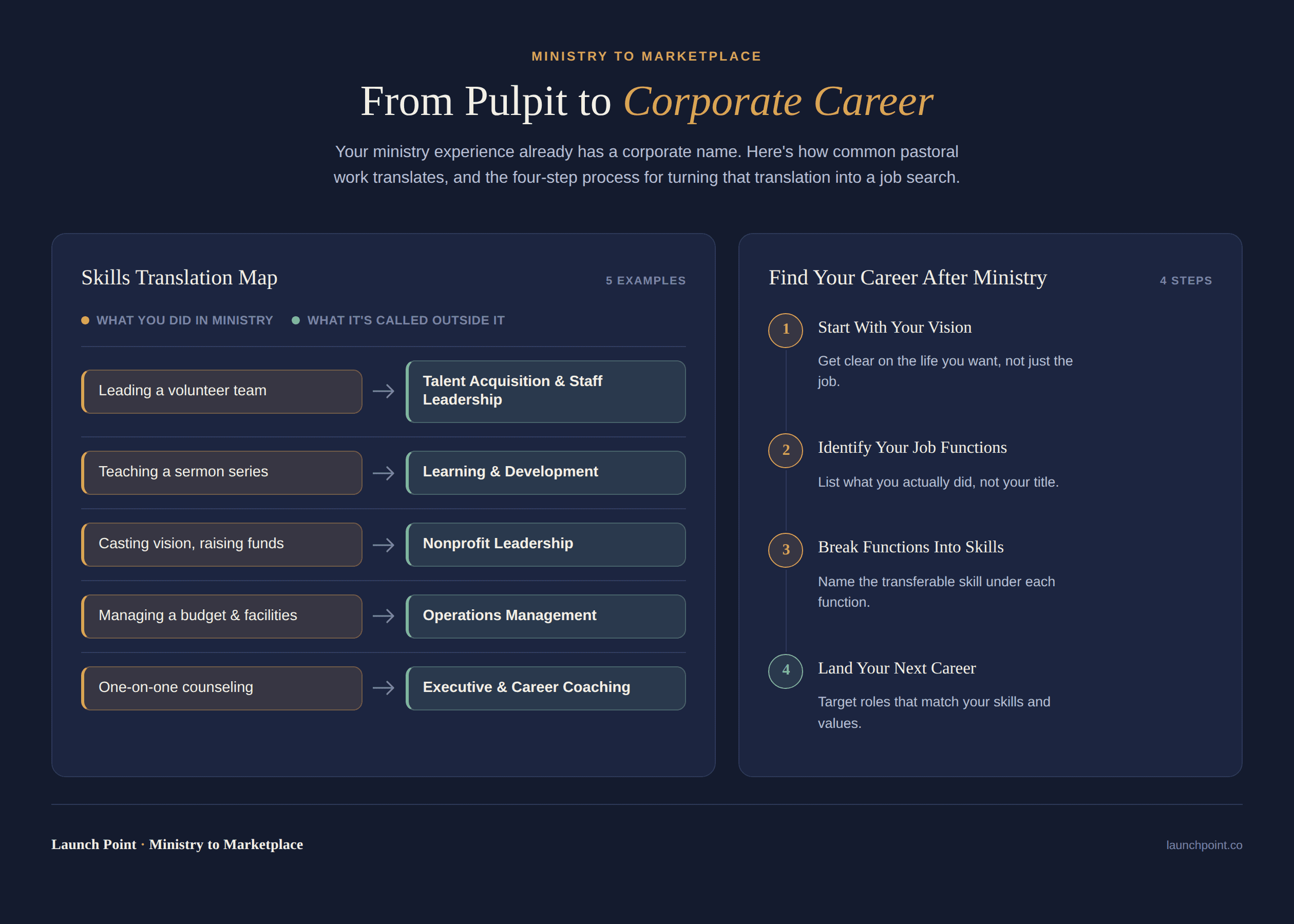
The visual below breaks down how your ministry experience lines up with corporate roles: leading a volunteer team looks a lot like talent acquisition and staff leadership, and casting vision for a building campaign looks like nonprofit leadership. Once you can name the corporate equivalent of what you did in ministry, you can search job boards by function instead of guessing at titles.
♟️ STRATEGY SHIFT: How to Find the Right Career After Ministry
Once you understand how your skills translate, the next step is narrowing your career options down to a short list you can actually pursue. Here's the process pastors in the Launch Point coaching group use to move from "I don't know what's next" to a clear target.
Start With Your Vision
Before you pick a job, get clear on the life you actually want: your family's needs, where you want to live, and how much time and energy you want to give to work. Vision comes first, because it filters out roles that technically fit but don't.
Identify Your Main Job Functions
List out what you actually did in ministry, not your title. Teaching, counseling, fundraising, event planning, and staff management are functions, and each one points toward a different career path.
Break Those Functions Into Transferable Skills
Take each function and name the transferable skill underneath it. Teaching becomes learning and development. Leading a volunteer team becomes staff management or operations leadership. Naming the skill, not just the activity, is what makes your experience legible to a hiring manager who has never worked inside a church.
Identify the Work You Actually Enjoy
Being good at something and enjoying it aren't the same thing. Rate each function on how much you enjoyed it, not just how good you were at it, and let that ranking guide which roles you pursue first.
Determine Whether You're Offense, Defense, or Both
Offense roles grow revenue or reach, like sales, marketing, or account management. Defense roles protect what already exists, like operations, finance, or risk management. Knowing which one energizes you narrows things to roles you'll actually want to keep doing five years from now.
Define Your Work Values
Work values are less about the job itself and more about the environment: fast-paced versus steady, structured versus flexible, team-based versus independent. Getting this wrong is why some people take a job that looks perfect on paper and still feel like something's off within a few months.
If you want a structured process for all six of these steps, with coaching and community built in, the Ministry to Marketplace Interview Accelerator walks you through it step by step.
How to Get Hired After Leaving Ministry
Clarity on your career options is only half the job search. The other half is getting your experience in front of the right people. A few things make the biggest difference:
Translate your resume into corporate language. Swap "shepherded a congregation of 400" for "managed a team and led change initiatives for a 400-person organization." Recruiters and hiring managers read resumes fast, and they're scanning for how your ministry experience maps to the role, not for ministry vocabulary they don't recognize.
Target roles, not just companies. Get clear on the best corporate jobs for former pastors before you start applying broadly. Then narrow your list to the companies that hire former pastors, since they already have a track record of valuing unconventional backgrounds.
Lean on your network. Most people who secure corporate jobs as a former pastor do it through a warm introduction, not a cold application. For a deeper walkthrough of the whole process, see our guide to former pastor job transition planning.
✅ DO THIS RIGHT NOW: Turn your ministry experience into a job search plan.
Use this checklist to move from research to action:
List your top five ministry job functions and the corporate role each one points toward.
Rewrite two bullet points on your resume in corporate language.
Pick three of the twelve roles above and search for open listings using that exact title.
Reach out to one person in your network who has already made a similar move.
Bookmark the companies you find and follow their hiring pages.
FAQs
What jobs can former pastors get?
You can pursue roles like project manager, operations manager, customer success manager, nonprofit development professional, and chaplain, among others. The best fit usually comes down to which pastoral functions you enjoyed most, not just which title sounds familiar.
What corporate jobs are good for former pastors?
Roles in project management, account management, and operations tend to be a strong fit, since they reward the same relationship-building and communication skills that ministry already built.
What skills do pastors have that transfer to corporate jobs?
Pastors typically bring strong communication skills, leadership skills, conflict resolution, event planning, and one-on-one counseling experience. These transferable skills apply directly to roles in human resources, marketing, and operations.
Can a pastor get a corporate job without corporate experience?
Yes. Most people land a first role by reframing their ministry experience in business language rather than by gaining new experience first. Hiring managers care more about demonstrated skills than about where you built them.
How do you translate pastoral experience on a resume?
Translate pastoral experience by naming the function behind each responsibility: leading a volunteer team becomes staff management, and fundraising for a building campaign becomes nonprofit development. Lead with results and numbers wherever you have them.
What can you do with a ministry or theology degree besides ministry?
A ministry or theology degree supports careers in counseling, nonprofit management, education, communications, and chaplaincy, along with roles that value strong writing, teaching, and communication skills over a specific undergraduate major.
Do former pastors need additional education to change careers?
Most moves into fields like project management or operations don't require additional education. Some paths, like licensed counseling or hospital chaplaincy, do require extra certification or fieldwork, so check the requirements for your specific target role early.
How can a former pastor find a job outside the church?
The fastest path is usually networking rather than cold applications: reaching out to people already working in your target field, asking for introductions, and applying to a short list of well-matched roles instead of a broad list of unrelated ones.
🚀 FROM THE COACHING GROUP
Job Clarity done! 🎉 I love that this process helps us dream a little bit and expand our view of what we bring to the table, what we value, and how those can play out in multiple contexts.
🤝 WHO WILL HIRE ME?: 5 ministry friendly organizations with jobs for ex-pastors.
Because of the time sensitive nature of job postings, we post these in the email newsletter only.
Get the newsletter, along with 1400+ others, every Friday morning.


How we can help you:
FREE Ultimate Guide To Your Ministry To Marketplace Transition Our entire process in a free (yes, FREE) guide that walks you step-by-step through the essentials of landing a marketplace job that you'll enjoy, and supports your family. Each section builds on the next: clarity, translation, resume, and LinkedIn connections… everything you need to start seeing traction in your search. You can sign up here >>> Sign up for the Ultimate Guide.
The Ministry To Marketplace Interview Accelerator Join 162+ others who have successfully transitioned from ministry into marketplace jobs that value their experience. The Interview Accelerator will give you our proven step-by-step process, coaching, and community for getting more interviews for jobs that value your ministry experience and support your family. Let's hop on a call!
Was this forwarded to you? Get this newsletter into your inbox, along with 1400+ others, every Friday morning. Subscribe here.