
How to Translate Your Ministry Experience for Corporate Jobs
Read Time: 5 minutes

Todd Linder
Founder & Head Coach
Overview
Turning what you did in ministry into words a hiring manager understands is one of the hardest parts of the job search. You know you led people, solved problems, and produced real results. The hard part is proving it without ever using the words "church," "congregation," or "sermon."
This guide covers how to identify which transferable skills you already have, swap ministry terminology for business terminology a hiring manager will recognize, and turn all of it into resume-ready bullets built on measurable results instead of vague duties.
Today's Ministry To Marketplace Minute:
Mindset Shift: Translating your vocational ministry experience and speaking the hiring team's language.
Strategy Shift: How to show your marketable skills as a former pastor in words that stick.
Do This Right Now: Step-by-step actions to translate your experience and update your resume wording.
Who Will Hire Me?: 5 ministry friendly organizations with jobs for ex-pastors
🧠 MINDSET SHIFT: Translate Ministry Experience Into Corporate Language
Here's the principle that changes everything: it isn't the most qualified candidate who gets the job, it's the one who can communicate that they're qualified. A hiring manager can only hire what they understand, and most have no framework for translating "led a congregation of 400" into anything they recognize from a job posting.
Hiring teams think in problems and solutions. A role gets posted because something isn't working, and they're looking for someone who has already solved a version of that problem. If your background still speaks in ministry terms, that connection never gets made, no matter how strong your leadership skills or communication skills actually are.
Think about how you'd choose a plumber. A generic "we fix pipes" ad doesn't build confidence the way "we specialize in stopping slab leaks before they flood your foundation" does. The second one proves the plumber understands your specific problem. Your materials need to do the same thing: name the reader's problem in terms they use, then show them you've already solved it before.
What Ministry Skills Transfer to Corporate Jobs?
Before you can translate any of this, it helps to see how much is already corporate-ready. Most pastors underestimate their transferable skills, simply because ministry rarely calls these skills by their corporate names.
Here's how common ministry responsibilities map to skills employers are actively screening for:
Preaching and teaching builds public speaking and communication skills. Weekly sermon prep is a crash course in distilling complex ideas into a message an audience can act on.
Discipleship and mentoring builds leadership development and coaching ability. You've spent years walking people through growth plans, which is functionally the same work as a corporate training or people-development role.
Leading volunteers builds team management and project management. Recruiting, scheduling, and retaining unpaid people is arguably harder than managing paid staff, since a paycheck isn't what keeps them showing up.
Counseling and pastoral care builds conflict resolution and interpersonal soft skills. Mediating marriage conflicts, staff disagreements, and congregational disputes is direct evidence of resolving conflict under pressure.
Running church operations builds technical skills, from budgeting and vendor management to the software and systems that keep an organization running.
Casting vision and driving growth builds strategic planning and change management, the kind employers look for in leadership roles at any size company.
The goal isn't to invent experience you don't have. Translating ministry experience means recognizing what's already there and describing it the way a hiring manager would describe their own team's accomplishments.
♟️ STRATEGY SHIFT: Turn Ministry Experience Into Resume-Ready Language
Turning your background into resume-ready language comes down to three moves: get specific about the corporate jobs you're targeting, use a repeatable framework to identify which of your accomplishments are actually relevant experience, and structure that into bullets built on results instead of responsibilities.
Step 1: Break Down the P.A.R.T.S. of the Job Description
Before you can translate anything, you need to know exactly what's being asked for. Break the job description down into its P.A.R.T.S.:
P = Problems: What problems is this role hired to solve, and for whom?
A = Actions: What actions will the person take to solve them?
R = Results: What does success look like, and how is it measured?
T = Technical Knowledge: What technical skills or systems does it require?
S = Soft Skills: What interpersonal and leadership skills matter most?
Pull 3 postings for the corporate jobs you're targeting, save them in one document, and run them through a P.A.R.T.S. Breakdown Tool to spot the problems, actions, results, and skills that come up again and again.
Step 2: Compare the Job Requirements to Your Ministry Experience
Once you know what a company cares about, go through each element and check off where your background already lines up. Did you solve a similar problem while leading a team? Did you take similar actions, produce similar results, or use similar technical and soft skills?
This step keeps things honest. You're not forcing your background to fit a role it doesn't match, you're identifying what's genuinely relevant and setting the rest aside.
Step 3: Translate Ministry Terminology Into Corporate Terminology
This is where most former pastors get stuck: they know the experience is relevant, they just don't know which words to use. Ministry vocabulary and corporate vocabulary describe a lot of the same work under different labels.
Here are common ministry terms and their corporate equivalents:
Ministry Language | Corporate Language |
|---|---|
Preaching | Public speaking, communication |
Discipleship | Leadership development, coaching |
Leading Volunteers | Team management, staff supervision |
Missionary Work | Program management, humanitarian work |
Starting a Ministry | Entrepreneurship, program launch |
Pastoral Counseling | Conflict resolution, employee relations |
Congregation | Client base, stakeholders, community |
Sermon prep | Content development, presentation design |
You don't need to memorize every swap. Run your target postings through a word cloud generator, or just note which words repeat across all 3. Those repeated terms are what an applicant tracking system and a human reader are both scanning for, and they should show up throughout, not just once.
Word choice does two jobs at once: it gets you past automated screening, and it builds confidence with the person reading it. The wrong choice raises a red flag before they finish the sentence. The right choice makes your accomplishments sound exactly like what's already on their team.
Step 4: Use Keywords From the Job Description
Once the terminology is translated, mine each posting for the specific keywords it repeats: certifications, software, and phrases from the requirements section. These aren't only for a human. Most companies run applications through an applicant tracking system before anyone opens them, and that system is scoring your materials against those exact keywords.
Keep a running list of keywords by target role and weave them naturally into your resume bullets and skills section. If a posting asks for "cross-functional project management" and your background involved coordinating volunteers, staff, and vendors on a building campaign, that's the keyword to use.
Step 5: Turn Your Experience Into Impact-Focused Resume Bullets
Once you've got the right language and the right keywords, structure them using the Impact Bullet Formula: Action + Result, backed by a metric or timeframe wherever possible.
A responsibility-based bullet just describes what you did. An impact-focused one proves what happened because you did it, and that distinction is what separates bullets a reader skims past from ones that get you a call back.
Here's what the Impact Bullet formula looks like:
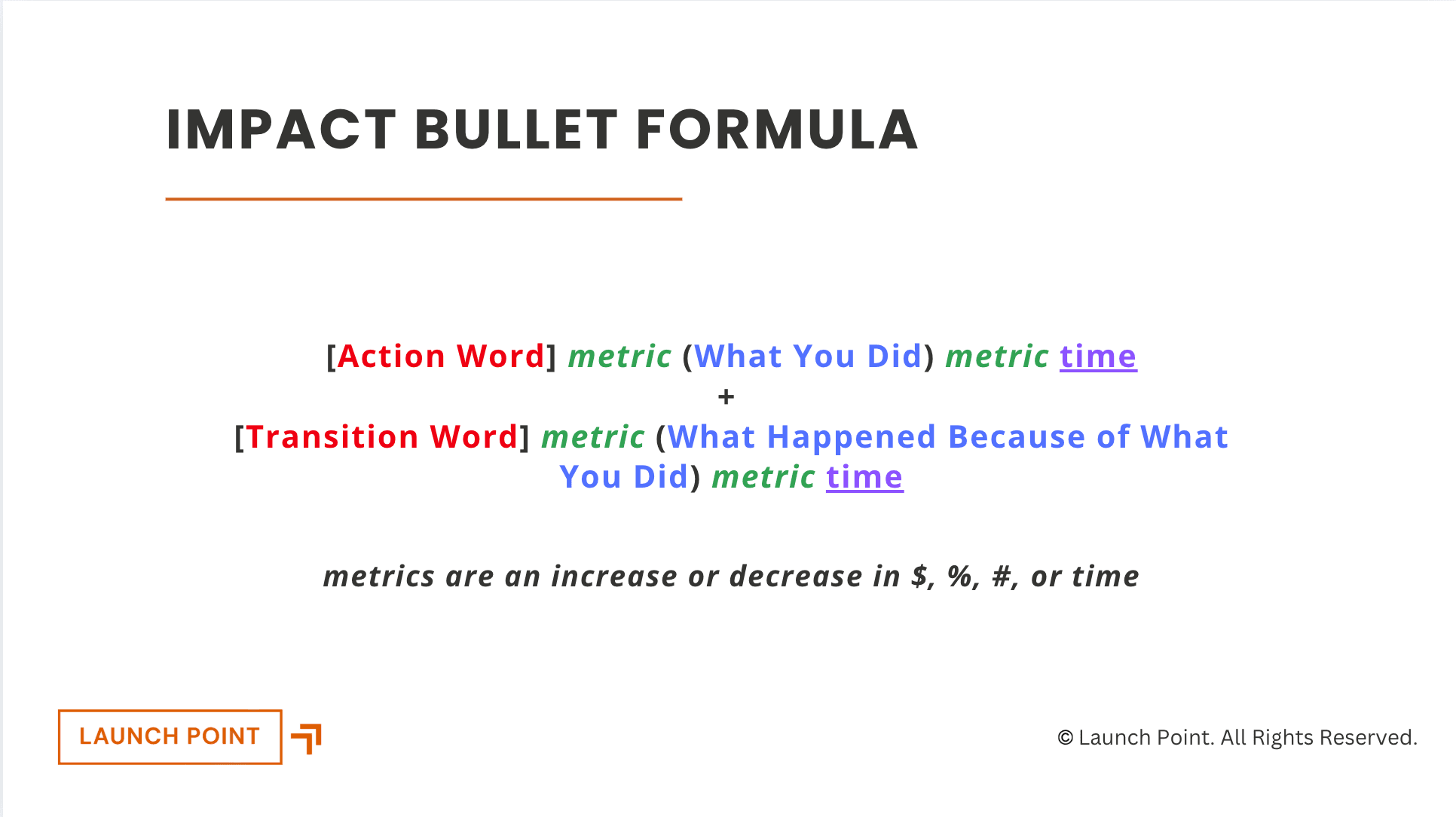
For each bullet, align an action with a corresponding result.
Then add metrics. Metrics can be an increase or decrease in a number, percentage, dollar amount, or time. Also, you can talk about a change over time. We have a whole section on this in the Interview Accelerator.
Example: Translating Pastoral Experience for a Corporate Job
Here's what this looks like in practice. Take a Community Pastor whose target job description read: "Managing and growing relationships with key customers, acting as their primary point of contact."
A Community Pastor could translate that experience this way:
"Served as the primary point of contact for every volunteer leader in a community group program, responsible for growing those relationships so leaders had everything they needed to succeed in their role."
Run the same accomplishment through the Impact Bullet Formula and it gets stronger with a metric attached:
"Served as primary point of contact for 40+ volunteer leaders, growing group leader retention by 25% year-over-year through consistent relationship management and support."
That single accomplishment, described in the right terminology and backed by measurable results, is what turns a Community Pastor into a Customer Success Manager on paper. The underlying experience didn't change. Only the language did.
✅ DO THIS RIGHT NOW: Update Your Resume Today
Pull 3 postings for the corporate jobs you're targeting and save them in one document.
Run each one through the P.A.R.T.S. Breakdown Tool to spot what they repeat.
Build a checklist of what you already have that matches.
Rewrite each checked item in corporate terminology instead of ministry terminology.
Reformat every bullet using the Impact Bullet Formula: Action + Result + metric.
Read it back and ask, "Would someone outside the church understand this in 5 seconds?"
FAQs
How do you translate ministry experience into corporate language?
You translate ministry experience into corporate language by identifying the transferable skills behind each responsibility, swapping ministry terminology for the equivalent business terminology, and describing the outcome in terms an outside hiring manager would immediately recognize.
What ministry skills transfer to corporate jobs?
Preaching, discipleship, leading volunteers, pastoral counseling, and running church operations all transfer to corporate jobs as the same communication ability, people-development skill, and hands-on management employers already screen for, just described in different words.
How do you put pastoral experience on a resume?
You put pastoral experience in front of a hiring manager by describing it in corporate terminology and measurable results instead of ministry titles and duties, structuring each line around the Impact Bullet Formula so the accomplishment, not the job title, is what stands out.
Should you include ministry experience on a corporate resume?
Yes. Leaving it off just creates an unexplained gap, while translating it turns years of relevant experience into an asset a reader can actually evaluate.
How do you describe preaching on a corporate resume?
Preaching translates well as public speaking and communication skills, especially when paired with a metric like audience size, frequency, or a specific outcome the message was meant to drive.
How do you describe leading volunteers on a resume?
Leading volunteers translates into team management or staff supervision, since recruiting, training, scheduling, and retaining unpaid people demonstrates the same leadership skills as managing paid employees, often under harder conditions.
How can pastors quantify their accomplishments on a resume?
Pastors can quantify accomplishments by attaching numbers wherever possible: volunteers managed, attendance growth, event size, budget managed, or retention rate, since quantifiable achievements are what turn a vague responsibility into proof of impact.
What ministry terms should you change on a corporate resume?
Terms like discipleship, congregation, sermon, missionary work, and pastoral counseling should be changed to their corporate equivalents, such as leadership development, client base, presentation, program management, and conflict resolution.
How do you tailor ministry experience to a job description?
You tailor it by breaking the posting down into its P.A.R.T.S., which is Problems, Actions, Results, Technical knowledge, and Soft skills, then matching your background to each element using the same keywords the posting uses.
Do corporate employers value ministry experience?
They do, when it's presented in terms they understand. The transferable skills built in ministry, from leadership to communication to project management, are genuinely valuable; this career transition simply requires translating that experience into something they can evaluate on its merits.
🚀 FROM THE COACHING GROUP
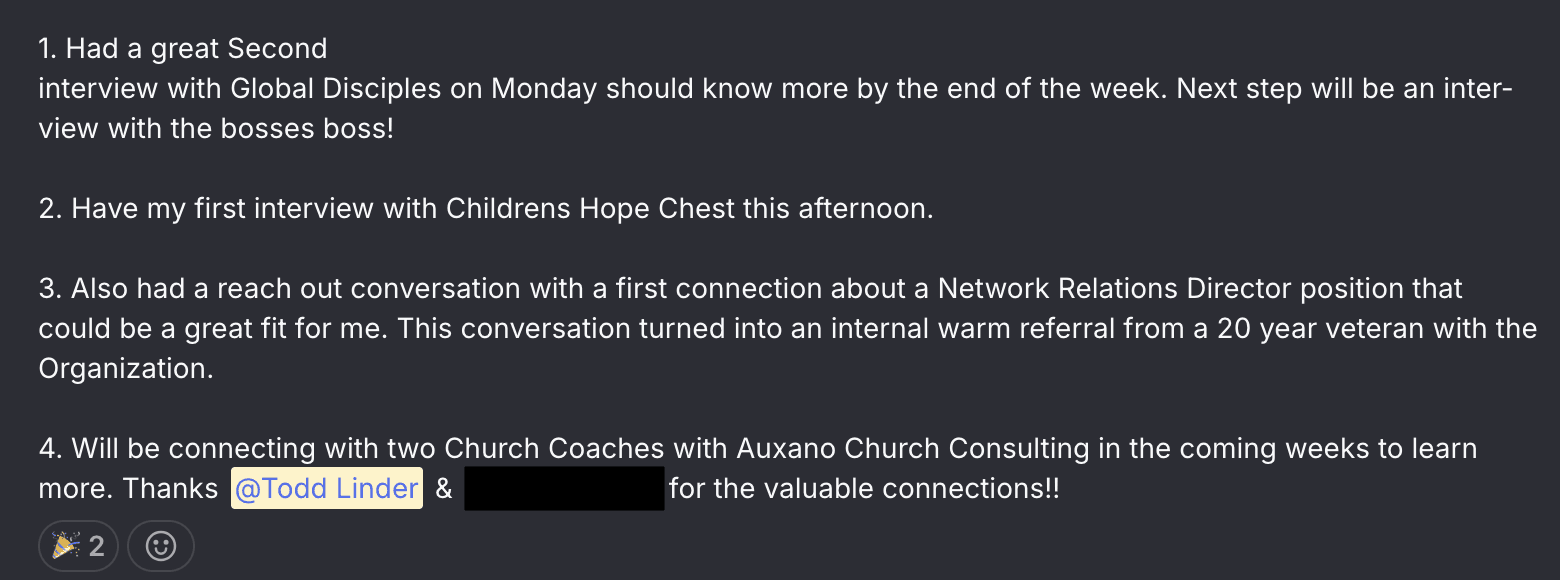
(2 interviews + another networking call.) Thanks @Todd Linder for the valuable connections!!
🤝 WHO WILL HIRE ME?: 5 ministry friendly organizations with jobs for ex-pastors.
Because of the time sensitive nature of job postings, we post these in the email newsletter only.
Get the newsletter, along with 1400+ others, every Friday morning.


How we can help you:
FREE Ultimate Guide To Your Ministry To Marketplace Transition Our entire process in a free (yes, FREE) guide that walks you step-by-step through the essentials of landing a marketplace job that you'll enjoy, and supports your family. Each section builds on the next: clarity, translation, resume, and LinkedIn connections… everything you need to start seeing traction in your search. You can sign up here >>> Sign up for the Ultimate Guide.
The Ministry To Marketplace Interview Accelerator Join 162+ others who have successfully transitioned from ministry into marketplace jobs that value their experience. The Interview Accelerator will give you our proven step-by-step process, coaching, and community for getting more interviews for jobs that value your ministry experience and support your family. Let's hop on a call!
Was this forwarded to you? Get this newsletter into your inbox, along with 1400+ others, every Friday morning. Subscribe here.