
The Ministry To Marketplace Method: 13 Proven Steps for Pastors Leaving Vocational Ministry to Land Corporate Jobs
Read Time: 9 minutes

Todd Linder
Founder & Head Coach
Overview
Welcome to the Ministry To Marketplace Minute! This one is for the people who don't know where to start - maybe you feel lost, stuck, or you just decided it's time to make a transition. Below is the full 13-step process used by all 81 people (at the time of this writing) to transition into the marketplace from ministry jobs, the 5 communication priorities that make each step click, and links to every deeper resource we've written on each part. Think of this as your table of contents for the entire transition - you're gonna want to save this one! So let's dive in.
Today's Ministry To Marketplace Minute:
Mindset Shift: Getting a marketplace job is completely different than a ministry job - and why you need a process that works.
Strategy Shift: The 13-step method (with 5 communication priorities and deeper resources) for getting a marketplace job.
Do This Right Now: Where do you need to start in the method?
Companies Hiring: 5 ministry friendly companies with open positions
🧠 MINDSET SHIFT: Getting a marketplace job is completely different than a ministry job.
If you don't have a process that works, your process might not work. I'm not sure who that quote is from, but it kinda makes sense. Right?
We've spent years honing our Ministry To Marketplace process for the Interview Accelerator. That's why the people who are following it are getting interviews every. single. week.
Quick side note: nothing beats coaching support and community - connections made within our community have directly led to multiple interviews for members in the span of just a couple weeks. If you're DIY, the method below is for you. If you're more of a "let's do it together" person, we'd love to have you in the Interview Accelerator.
You've decided you want to transition from ministry. Now what?
Maybe you're early in the process. Or haven't even started. Let's lay it out.
Searching for a job in a non-ministry position is a completely different mindset from a ministry position.
How you apply for jobs is different.
How you present your value is different.
How you interview is different.
Even how you think about your future is different (you've probably already noticed this one).
And it starts with your mindset.
In the ministry world, character often holds equal or greater weight than competency.
In ministry, you're a generalist. You figure it out with limited resources. That's what you do. So whether you can objectively do the functions of the job is important, but less important.
In non-ministry, character is often the last question being asked. Culture fit is evaluated along the way, but personality and "vibe" matter more than whether your marriage is intact or your kids are obedient (that would actually be illegal to ask about in interviews).
Whether you can objectively do the job as outlined in the job description or not is priority number one. That is what gets you into the first interview and beyond.
So reality check: in 99% of cases, you can't use your "ability to lead people," charisma, and small talk to scoot your way to an offer. At least at great companies, you won't be able to.
Here's another way to think about it: the job search is like sports.
Every sport has seasons. Pre-season, regular season, post-season, and off-season.
In the same way, the job search has these. What is going to get you the best results is recognizing that your best job search results will happen when you have a great pre-season and regular season.
Pre-season is where you do the work. Before the wins and losses. Get the reps in, learn the plays, and build the team. This is all of the prep work so that you make every conversation, every application, and every interview count.
Regular season is the process of getting the interviews that will lead to offers. That's where we count the wins and the losses.
♟️ STRATEGY SHIFT: The method of getting a marketplace job.
Let's talk about the method. The step-by-step process that every client in the Interview Accelerator follows to get more interviews for the jobs they actually want, faster. If you do these things, in this order, you will get better results - we've seen it every time.
Everything, and I mean everything, in this method is about communication. There are 5 essentials you want to master communicating as you exit your ministry vocation and step into the marketplace, all of which we help you do in the Interview Accelerator:
Can you clearly communicate the type of job you want in a networking conversation?
Can you communicate to a hiring manager what you have done in language that makes sense to them?
Can you communicate that you are an attractive candidate through assets like your resume, LinkedIn, and cover letters?
Can you communicate in interviews that you understand and can fulfill the PARTS of the job description for a role you're applying for?
Can you communicate why this next step in your career journey makes sense by telling your story effectively?
We've also put our entire process in one place: the FREE Ultimate Guide For Your Ministry To Marketplace Transition walks through every training we cover in the Interview Accelerator. Below is the detailed step-by-step, plus links if you want to go deeper on any part.
Here's how those 5 priorities show up inside the 13-step method:
Pre-season:
Focus on getting your mind right and setting good expectations for the success rate and how long the job search will take. It will always take longer than you think, and success is closer to 30% than 70%. A few things worth remembering: the game has changed in the last 10 years, 5 years, 2 years - even the last 3 months. Relationships are everything, people trust AI less, and the person who communicates their fit to the job the best gets the job. Also, doing 20 hours of the wrong things will get you less progress than doing 3 hours of the right things - hard work matters, but smart work matters more. Both are required to win this game.
Get clarity on the types of jobs you are aiming for next (title and level), and make sure you can clearly communicate this in a networking conversation. If you can't communicate what you want to do or where you want to go, you'll never get there. You'll be aimless. Without this clarity, you also won't be able to create an effective resume, cover letter, or LinkedIn profile, or look like a top candidate in interviews.
Go deeper: How To Get Unstuck On Your Job Search, How Long Does It Take To Get A Corporate Job After Ministry?, Best Jobs for Pastors
Translate your experience so that it makes sense to hiring managers for that specific job you are aiming for. This isn't just about words; it is about only having experience on your resume that aligns with the job descriptions you will see. Translating your ministry experience into words and phrases that someone who has never worked in ministry can understand is the mountain you must climb to enjoy skiing down the other side. This is the most difficult part, but the part that makes the most difference.
You speak Christianese. They speak… business. Functionally, your job may be incredibly similar to what the company wants to accomplish with a specific role. But what you called it at your church or ministry was completely different. Speak their language, and help them understand how you can serve their team - learn to speak it like you're moving to a foreign country with only native speakers (ChatGPT can only help you so much here). We created a list of 41 words that you can translate on your resume right now to make your resume look less ministry while keeping the functionality intact.
Go deeper: How To Translate Your Ministry Experience for Corporate Jobs
Build the assets that make you an attractive candidate: your resume, LinkedIn, and cover letter. In 99.9% of cases, creating these is non-negotiable - it's standard practice. You also need to stand out from the crowd by having the right wording (translation) and the right metrics to prove that you've produced results before, and that you can do it again. Format matters just as much as wording - recruiters take an average of 7.4 seconds to read each resume, so make it easy to scan.
Go deeper: Building a Resume That Showcases Your Marketable Ministry Skills, The 9 LinkedIn Profile Essentials for Pastors Making a Career Change, Do Former Pastors Need A Cover Letter for Marketplace Jobs?
Tailor your resume to the job description using the P.A.R.T.S. framework, so you can communicate in interviews that you understand and can fulfill what the role needs. Instead of going through your resume line by line and seeing what you can make look like the job description - or asking ChatGPT to do it - go through the P.A.R.T.S. of the job description:
What are the PROBLEMS the role is supposed to solve?
What are the ACTIONS the person in the role will take to solve the problems?
What are the RESULTS the role should achieve?
What is the TECHNICAL EXPERTISE needed to take the actions that get the results?
What are the SOFT SKILLS needed to get the results, especially when doing it in a team context or being customer-facing?
Yes, tailoring every resume this way is real work, but a BDR at one company does things differently than a BDR at another - different products, different clients, different industries, and different processes mean the PARTS breakdown changes role to role, even when the title looks identical.
Craft your story - not just why you're transitioning from ministry, but why the next role you're looking for makes sense. Many people won't understand why you are transitioning from ministry (I get messages sometimes from people saying that I'm actually hurting the kingdom of God with what I'm doing… seriously). Your story should include things you have always enjoyed, responsibilities you've performed, and the mindset behind why you've taken certain jobs. If those things are similar to the next job, people will be better able to connect the dots on your next logical step.
Go deeper: Interview Questions To Expect When Leaving Vocational Ministry As A Pastor, How To Explain Your Ministry Career Change In Interviews
Identify who the people are who will help you by cheering you on and making introductions for you. 15 people minimum on this list.
Go deeper: Who Will Help You Get A Job As A Former Pastor?
Regular Season:
Now identify "Target Organizations" - places that you want to work, that will pay you what you need to make, that will see your ministry background as an asset rather than a liability. Have a list of 30 you are targeting at all times. Remember: applications don't equal interviews, and applications don't lead to offers - interviews lead to offers, so your main strategy question should always be "how can I get more interviews?" Between 1-2% of applications lead to interviews; having an internal connection can be upwards of 15x that. Targeting companies that are (or will be) hiring for the job you want and where you have connections is the fastest way to bypass the ATS and get into an interview where you have a better shot at an offer.
Create a list of connections that will be more likely to help you and have a conversation with you if you reach out to them. This will include people you know and people who don't know you… yet. I recommend 200.
Start reaching out to that list. 50 people per week. Aim to get introductions that lead to interviews, but don't be weird about it. Build up your social bank account so that when you make a withdrawal, you've got a positive balance to withdraw from. Your best process is a mix of quality and quantity - we call this "The Success Equation": (higher quality and quantity of connections) + (higher quality and quantity of conversations) x (how many reachouts you do per week). Increase your luck surface area, if you will.
Audit weekly. What's working? What isn't working? What do you need to change? Which Target Organizations are hard to connect with? Which people are you getting traction with, and which ones are ghosting you? While you're at it: following up is a level-100 skill. We've had people land jobs because they followed up with a company months after not getting an offer the first time. Follow up after interviews. Follow up after applications. Follow up after "rejections." Follow up after introductions. Always, always, always follow up.
At the end of the month, prune the non-responsives and get back up to the target numbers.
Repeat until you get a job.
Go deeper: Who Will Hire Me As A Former Pastor?, How To Stand Out In The Job Search As A Former Pastor, 15X Your Interview Chances After Leaving Vocational Ministry, How To Get More Interviews At Your Dream Organization When Leaving Ministry, How To Get Predictable Interviews After Leaving Vocational Ministry
Once you're in the interview:
Interviewers are looking for very specific things, and each interview has a different purpose.
Phone screens are to get to know you and confirm you are who you say you are on your resume.
Initial interviews are for understanding your qualifications better and getting to know you as a person.
Final interviews have much more to do with your likability.
Interviews progress from competency in the beginning to likability and culture fit at the end.
✅ DO THIS RIGHT NOW: Where do you need to start in the method?
Access the FREE Ultimate Guide For Your Ministry To Marketplace Transition - it walks through every training we cover in the Interview Accelerator, step by step.
Look at the Strategy Shift section above. What have you done? What haven't you done?
Go to the earliest number in the method that you haven't completed, and start there. Don't move on until you finish it.
If you're stuck on which piece to prioritize, pick the highest item on the list that you don't have clarity on how to communicate yet, and work on that - and only that - until it's figured out.
Hint: this is the waterfall effect. If you do these in order, much of the work ends up taking care of itself!
🚀 FROM THE COACHING GROUP
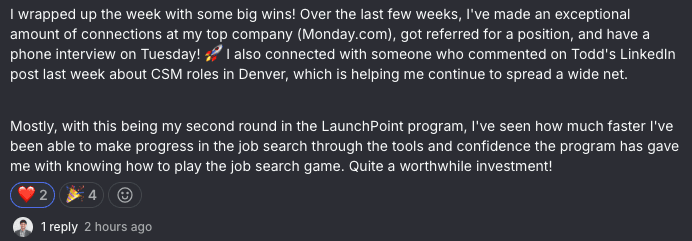
Over the last few weeks, I've made an exceptional amount of connections at my top company (Monday.com), got referred for a position, and have a phone interview on Tuesday! 🚀
🤝 WHO WILL HIRE ME?: 5 ministry friendly organizations with jobs for ex-pastors.
Because of the time sensitive nature of job postings, we post these in the email newsletter only.
Get the newsletter, along with 1400+ others, every Friday morning.


How we can help you:
FREE Ultimate Guide To Your Ministry To Marketplace Transition Our entire process in a free (yes, FREE) guide that walks you step-by-step through the essentials of landing a marketplace job that you'll enjoy, and supports your family. Each section builds on the next: clarity, translation, resume, and LinkedIn connections… everything you need to start seeing traction in your search. You can sign up here >>> Sign up for the Ultimate Guide.
The Ministry To Marketplace Interview Accelerator Join 162+ others who have successfully transitioned from ministry into marketplace jobs that value their experience. The Interview Accelerator will give you our proven step-by-step process, coaching, and community for getting more interviews for jobs that value your ministry experience and support your family. Let's hop on a call!
Was this forwarded to you? Get this newsletter into your inbox, along with 1400+ others, every Friday morning. Subscribe here.