
How Former Pastors Can Stand Out in Job Interviews
Read Time: 4 minutes

Todd Linder
Founder & Head Coach
Overview
Welcome to the Ministry To Marketplace Minute! Today we're breaking down how to succeed in interviews. We'll start with what interviewers are actually looking for and how you can position yourself well, then get more granular on each type of interview you'll encounter, what to expect in each one, and how to prepare - so you can get deeper in the process and get more offers. So let's dive in.
Today's Ministry To Marketplace Minute:
Mindset Shift: The ex-pastor’s way to get a new job - and win it.
Strategy Shift: Winning in interviews when transitioning from ministry.
Do This Right Now: Position yourself well, and fix where you're getting stuck.
Who Will Hire Me?: 5 ministry friendly organizations with jobs for ex-pastors.
🧠 MINDSET SHIFT: The ex-pastor's way to get a new job - and win it.
I want you to change the way you think about interviews.
Interviews are not conversations with people who may or may not like you or hire you.
Interviews are opportunities to get hired.
Every. Single. One.
That’s why you might have heard me say, “We measure success as how fast you can get interviews for jobs that you want that will support your family.”
Because if interviews are opportunities to get hired, then we want to create as many opportunities as possible as fast as possible.
That means that knowing how to win in interviews is just as important as getting them.
Here's the other half of that mindset: the interviewer wants you to win.
Wait, what? Did I really just say that?
Yep, the interviewer wants you to win.
Quick story.
When I was interviewing for jobs, at some point, I took on the belief that I was up against the world. That every interview was a test. That the interviewer was looking for my gaps and my mistakes.
But then I got a job in corporate HR and I realized 2 things.
I was wrong. The interviewer actually wanted to find the best candidate for the position. And if I was being interviewed, they actually thought I had a chance. They want to find someone to fill the role just as much as I wanted to be the one to fill it! If I was the right person, they wanted me to be the right person.
I was wrong. That mentality, that filter, did not serve my job search. I entered every interview trying to prove something and hide the bad stuff, rather than being the type of person who would add value to the organization.
Basically, I was acting like someone who needed to prove themself because that's what I believed about myself and the way interviews worked.
Rather than acting like someone who was looking to serve an organization with my experience so that they could accomplish the goals they set out to achieve.
Slight difference in mindset. Drastic difference in how I presented myself.
What if you’re getting interviews, but not offers?
I hear people tell me, “Todd, I’m getting interviews, but none of them are leading to offers - and I don’t know why.”
Here's what you need to know:
Why some candidates get chosen, and others rejected.
How interviewers keep score when evaluating candidates.
How you can position yourself well, even without a background that is apples to apples, on paper.
Each type of interview you will likely encounter, and the purpose of that interview.
What to expect in each one.
How to prepare to interview so you get the offer.
♟️ STRATEGY SHIFT: Winning in interviews when transitioning from ministry.
Let’s start with what hiring teams are ACTUALLY looking for.
We call becoming a top candidate “becoming an A Player.”
This concept comes from a well known recruiting book that defines an A Player as: A candidate who has at least a 90% chance of achieving outcomes that only the top 10% of possible candidates could achieve.
In practice, this means:
You want your resume to match at least 90% of the job description.
Your resume needs to show that you are a top 10% performer through demonstrating excellence and exceeding expectations through stories and metrics.
Not only do we help you to get more opportunities to get offers in the Interview Accelerator, but we help you show up as an A Player.
Why do some candidates get chosen?
To get an offer sooner, you need to know what hiring teams are looking for. Here’s how candidates get evaluated.
Mission alignment: Does the candidate understand why the job exists and the business problem that is being solved for?
Outcomes: The specific, measurable results the candidate needs to achieve.
Competencies: The actions, technical skills, and soft skills required to win in the role.
Beyond these, bonuses for being a top candidate include,
Being known for the value they bring outside of the resume, just through networking.
Being liked for how their career journey fits the organization (presented through telling your story)
Being trusted to exceed expectations.
Feeling discouraged that you’re not qualified enough?
Reminder: it is not the person who is the most qualified that gets the job, it is the person who can communicate they are the most qualified FOR THE JOB that gets the job.
What this means is that for most companies, charisma, smooth talking, and “I can learn anything” don’t work.
If those have been your answers, they likely won’t cut it.
How interviewers keep score.
Most hiring teams will use a basic scorecard. A series of important characteristics that each interviewer will be looking for and scoring the candidates on. This helps to ensure more consistency across candidate evaluations.
Most likely, the scorecard will evaluate those three core areas from above: Mission, Outcomes, and Competencies.
We further break these down as the P.A.R.T.S. of the job description. If you know how to tell stories about PARTS, you know how to score well on the scorecard.
You can read in depth about the P.A.R.T.S. of the job description in this newsletter HERE.
Positioning yourself well.
What if you don’t have a perfect background that aligns well?
If you got into the interview, there is a reason. Someone is at least curious.
Three ways you can become more attractive as a candidate.
Tell stories about how you have done similar things with outsized results.
Highlight core competencies by weaving them into your stories.
Address the gaps in experience head-on.
Stories
If you have done something similar that yielded a similar or better result than what they are hoping for, that can make sense in the mind of the interviewer. Your job is to connect the dots on why your experience makes sense. Stories are the best way to do that.
Core Competencies
In general, there are nine core competencies that hiring teams value across most roles:
Assertiveness
Analytical skills
Attention to detail
Efficiency
Integrity
Planning and organization
Follow-through
Proactiveness
Adaptability
Weave these into your stories to show how you bring these to the table.
But what about the gaps?
Address them honestly and head on. The worst thing you can do is not talk about them, because then everything is based on assumption once you’re out of the room. If someone thinks that all you do is drink coffee with people and talk from a stage once or twice a week, they don’t understand what you do. But you can’t know what they think unless you bring it up.
To sum it all up, your job in interviews is to be the most attractive candidate possible by communicating that you are the most qualified FOR THE JOB,
Through your stories
Through clear results you’ve accomplished that are relevant to the job
And by calling out the gaps before they can be counted against you.
So what about the interviews themselves?
If you can walk into interviews with the right mindset and know how you'll be evaluated, you're more likely to win. But you also need to know practically what to expect at each stage.
Here are the different types of interviews you will encounter in almost every job search process:
ATS and Resume Review
Phone Screen
Who Interview
Focused Interview
Final Interview
Let's go through each.
ATS and Resume Review
The application, when your resume is reviewed, is opportunity number 1. You will need to go through this step to get the first interview when you are talking to an actual human (phone screen)...
Or do you?
Yes, actually, you can bypass the ATS to get more interviews without having to cold apply for jobs and bank on your ministry resume + ChatGPT working.
ATS stands for Applicant Tracking System. There's a lot of mumbo jumbo about ATS systems, auto-rejections and AI out there, so we wrote a newsletter to clear it all up that you can read here: When AI Rejects Your Resume: How To Beat Auto-Rejections and Get More Interviews as a Former Pastor.
This is actually what we do all day, every day in the Interview Accelerator. Our clients average over 35% interview rate - some closer to 50%! (1 interview for every 2 or 3 applications submitted)
The Phone Screen
This is a short call (usually 20–30 minutes) to check if you're a potential "A Player" (see above). The interviewer, who could be a recruiter, someone in talent acquisition, or the hiring manager, wants to know
Is your resume real?
Do you understand the role?
If your career aspirations align?
This is about filtering out candidates who aren't a good fit before involving the hiring manager.
How I'd prepare:
Prepare a clear, concise "throughline story" that connects your past, present, and future to the role you're applying for.
Research the company and role deeply. Know more than every other candidate.
Be ready to answer questions about your experience, why you're interested, and how your goals align with the job.
Practice being engaging and personable. This is about showing you're someone they'd want to work with every day!
The Who Interview
A deeper dive into your job history and how it aligns with the position and organization. They're looking for patterns of success and want to see if you're likable and if your experience matches what they need. This is where you start building trust and likability. Most likely with the hiring manager.
How I'd prepare:
Be ready to walk through your career history, focusing on highs, lows, wins, and losses.
Use the G-STAR framework (Goal, Stakes, Task, Action, Result) to structure your stories and show how your experience matches what they're looking for.
Frame reasons for leaving previous jobs positively. Focus on growth, alignment, and opportunity, not complaints or blame.
Keep answers concise and offer to elaborate if they want more details.
The Focused Interview
Often with a panel or one to two higher-ups. This stage digs deep into your competencies and outcomes. They're looking for proof that you're not just capable, but a top 10% performer for the role. Expect fewer questions but more follow-ups and specifics. They're also beginning to evaluate culture fit more deeply.
How I'd prepare:
Study the job description and the scorecard (the rubric interviewers use to rate candidates, covered above).
Prepare specific stories that demonstrate the competencies and outcomes they care about.
Expect follow-up questions and be ready to go deep on your examples.
If it's a panel, be prepared for unexpected or off-the-wall questions.
The Final Interview
At this stage, everyone is qualified. This might be with the hiring manager again or with that person's boss. The focus is on finding the best fit for the team and the specific problem they need solved. Sometimes, the offer goes to the person with the most relevant experience, but you can still stand out by demonstrating strong core competencies and the ability to learn quickly.
How I'd prepare:
At this point, everyone can do the job. Focus on demonstrating your unique strengths, especially if you don't have the most experience.
Highlight core competencies: efficiency, integrity, planning, organization, follow-through, proactiveness, and adaptability.
Use metrics and stories to show you consistently exceed goals and learn quickly.
Be confident, but also show you're a great fit for the team and culture.
✅ DO THIS RIGHT NOW: Position yourself well by doing these things.
Evaluate from the Strategy Shift section what you need to do to become an A Player, and change those things. Focus on:
Aligning your stories to the job description.
Weaving core competencies into your stories.
Creating a script for addressing objections to your background head-on that you can use in the interview.
Then, evaluate which type of interview you usually get stuck in during the process. Do you not get past the phone screen? Or can you make it all the way to final interviews but not get the offer?
Review the notes from the Strategy Shift section for that interview stage where you tend to get stuck.
Focus on making changes in preparation for the next one so you can get further in the process next time.
🚀 FROM THE COACHING GROUP
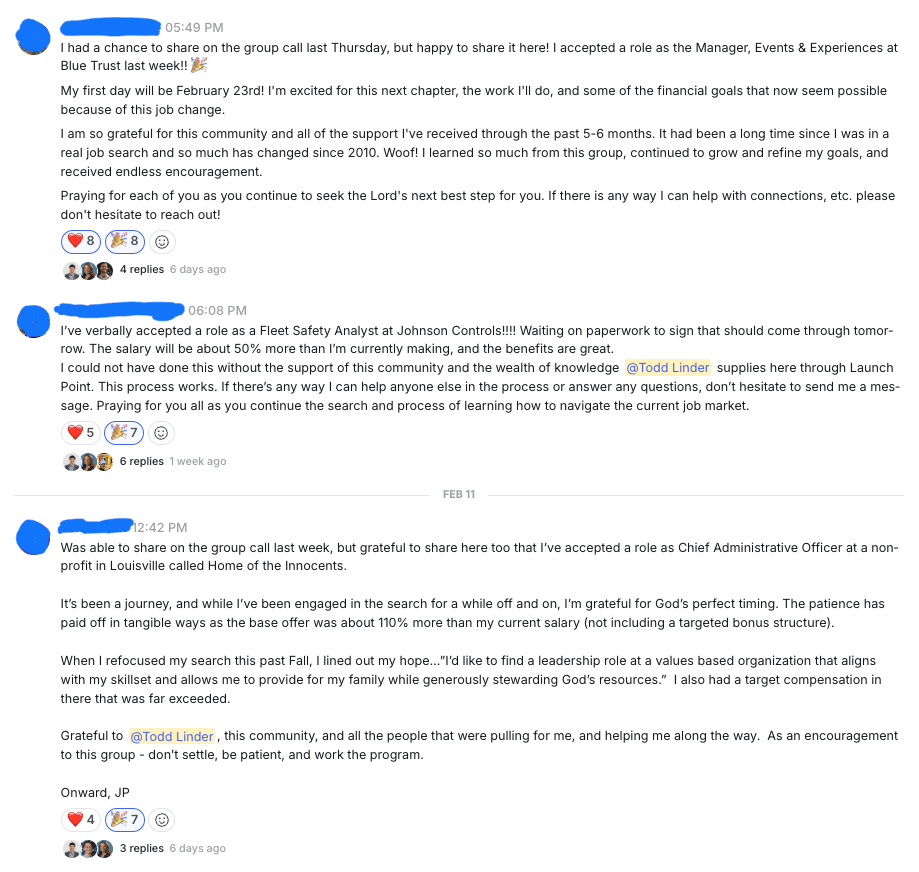
3 job offers in 48 hours! Huge celebration in the community!
🤝 WHO WILL HIRE ME?: 5 ministry friendly organizations with jobs for ex-pastors.
Because of the time sensitive nature of job postings, we post these in the email newsletter only.
Get the newsletter, along with 1400+ others, every Friday morning.


How we can help you:
FREE Ultimate Guide To Your Ministry To Marketplace Transition Our entire process in a free (yes, FREE) guide that walks you step-by-step through the essentials of landing a marketplace job that you'll enjoy, and supports your family. Each section builds on the next: clarity, translation, resume, and LinkedIn connections… everything you need to start seeing traction in your search. You can sign up here >>> Sign up for the Ultimate Guide.
The Ministry To Marketplace Interview Accelerator Join 162+ others who have successfully transitioned from ministry into marketplace jobs that value their experience. The Interview Accelerator will give you our proven step-by-step process, coaching, and community for getting more interviews for jobs that value your ministry experience and support your family. Let's hop on a call!
Was this forwarded to you? Get this newsletter into your inbox, along with 1400+ others, every Friday morning. Subscribe here.