
How to Build a Resume as a Former Pastor: 7 Tips for Your Career Transition
Read Time: 7 minutes

Todd Linder
Founder & Head Coach
Overview
If you're staring at a blank page trying to turn twelve years of ministry into something a stranger will understand in ten seconds, you're not alone. Most former pastors don't lose interviews because they lack experience. They lose them because their application materials never translate that ministry experience into language a hiring manager recognizes. This guide covers how to lead with transferable skills, the six sections every standout application needs, whether to change your title, and how to tailor what you submit for each opening. For more foundational resume tips and answers to common transition questions, that's a good place to start too.
Today's Ministry To Marketplace Minute:
Mindset Shift: Becoming an attractive candidate as a former pastor - starting with your job title.
Strategy Shift: Design the resume (and your job title) to show your ministry marketable skills.
Do This Right Now: Redoing your resume structure.
Who Will Hire Me?: 5 ministry friendly organizations with jobs for ex-pastors.
🧠 MINDSET SHIFT: How to Build an Effective Resume as a Former Pastor
Recruiters and hiring teams spend five to ten seconds on a first pass through your materials, and they're doing it in a stack of forty other applications, not a one-on-one conversation. That changes what this document is for. It isn't a record of your ministry calling. It's a marketing piece that has to prove, at a glance, that you can do the job being advertised.
That's a hard shift for a lot of former pastors. In ministry, your role was understood by everyone around you. In a corporate job search, nobody knows what a "Discipleship Pastor" or "Executive Pastor" actually did day to day, and most readers won't take the time to guess. Your materials have to do that translating for them, using keywords a recruiter would recognize and an applicant tracking system (ATS) would flag as a match. If your page still reads like a ministry job posting, it's working against you before a human ever sees it.
Focus Your Resume on Transferable Ministry Skills
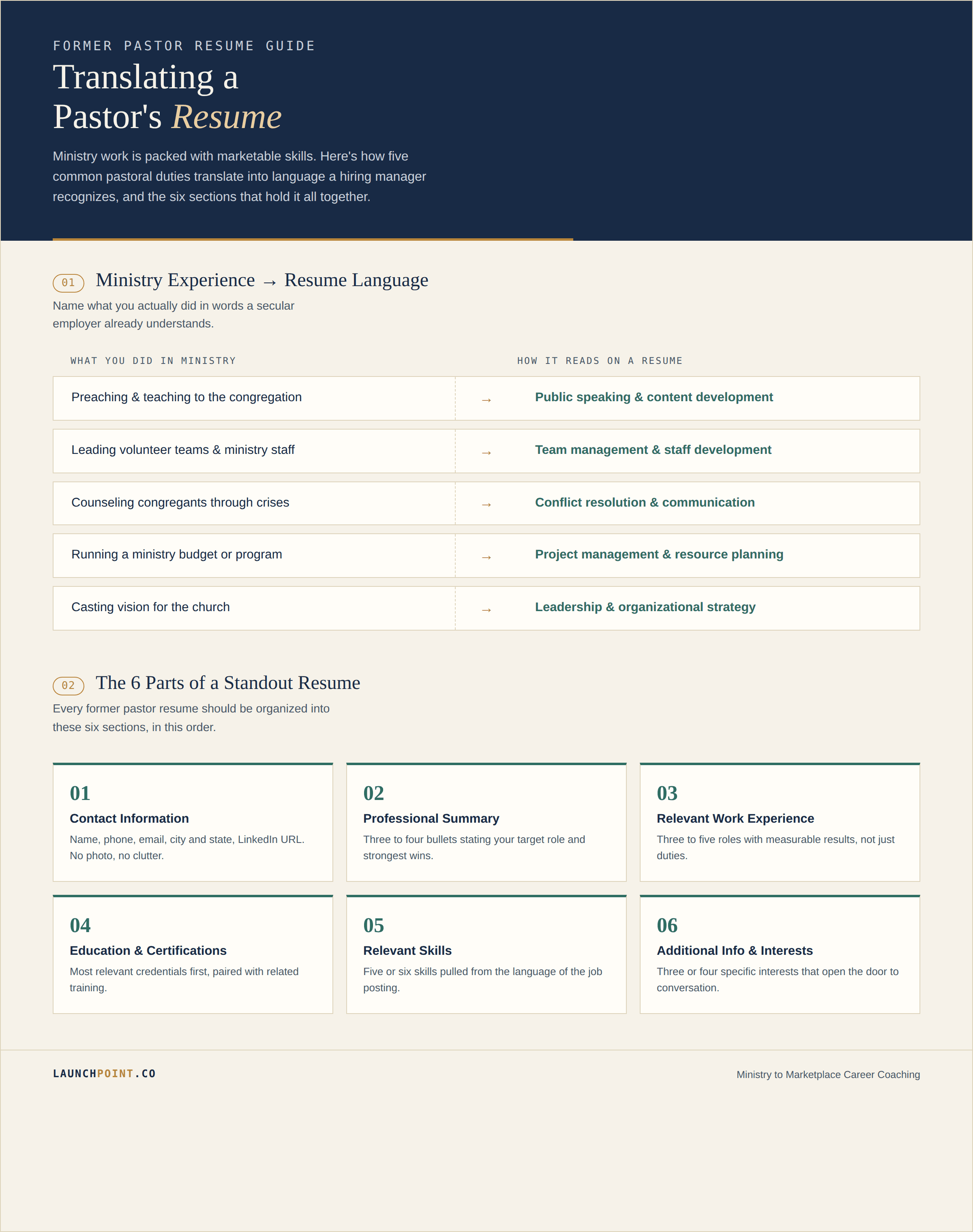
Before you touch formatting, get clear on the transferable skills buried inside your ministry experience. Nearly everything a pastor does maps to a skill employers are actively hiring for. Here's the translation in practice:
Preaching and teaching became public speaking and content development in front of large audiences.
Leading volunteer teams became team management and staff development.
Counseling congregants through crises became conflict resolution and stakeholder communication.
Running a ministry budget or program became project management and resource planning.
Casting vision for a church became leadership skills and organizational strategy.
Naming these plainly, rather than in church language, is what makes your pastoral experience legible to someone who has never worked inside a church. It's also how you turn years of ministry experience into a story that reads as directly relevant professional experience, not a side note. For a deeper walk-through of how to turn ministry duties into resume-ready language, that guide breaks the process down job posting by job posting.
♟️ STRATEGY SHIFT: The 6 Parts of a Standout Former Pastor Resume
Once you know which transferable skills to highlight, structure matters more than almost anything else. Your materials need to be both easy for automated screening software to parse and easy for a human to scan in seconds. Here are the six sections that make that possible.
1. Contact Information
Keep this section minimal: name, phone number, email, city and state (no full street address), and a LinkedIn URL. Skip a headshot and skip decorative design elements. Most ATS platforms can't parse photos, tables, or graphics reliably, and they can distract from the content that actually gets you the interview.
2. Professional Summary
Three to four tailored bullet points, positioned right under your contact information, that state your target role and your strongest wins up front. This is the section a hiring manager reads first, so it should include your career transition story in one line and a few resume keywords pulled directly from the posting you're applying to.
3. Relevant Work Experience
List three to five roles, most recent first, and describe each with measurable results instead of duties. Instead of "oversaw church operations," write "managed a $400K annual budget and a team of 12 staff and volunteers." Numbers convert vague ministry experience into accomplishments a recruiter can compare against other candidates' work experience.
Should Former Pastors Change Their Job Titles on a Resume?
This is one of the most common questions former pastors ask, and it deserves an honest answer: it depends, and it's not dishonest to do it. A title is just a reference point for the actions, functions, and results of a role inside a specific organization. If you performed 80% or more of the responsibilities tied to a comparable secular title, adjusting your job title to match is a reasonable, honest choice. It also helps you get found: recruiters searching an ATS by title won't find "Lead Pastor" when they're searching for "Operations Manager," even if your actual work overlaps closely. Keep your responsibility level accurate; only claim a higher level of authority if the target role genuinely supports it.
4. Education and Certifications
List your most relevant credentials first. A Master of Divinity is worth including, especially for roles built around communication, counseling, or leadership, but pair it with any certifications or training more directly tied to the job description you're targeting so it doesn't read as your only qualification.
5. Relevant Skills
Keep this section focused rather than an exhaustive list. Aim for five or six relevant skills, weighted toward what the job description asks for: leadership skills, communication skills, project management, team management, and public speaking are common strengths former pastors bring, but pull the exact phrasing from the posting whenever it matches your real professional experience. This is also where a handful of well-chosen keywords do the most work for getting past automated screening.
6. Additional Information and Interests
Close with three or four specific, non-work interests. This section is small but it humanizes your application and gives an interviewer an easy, low-stakes question to open with.
Getting all six sections right on your own can take hours of trial and error. If you'd rather have a coach walk through it with you, Interview Accelerator is built for exactly that.
Tailor Your Resume to Each Job
A former pastor resume that works for one opening rarely works unedited for the next. Before you submit, read the job description closely and mirror its language, especially in your professional summary and skills section. Automated screening software is matching keywords against the listing, and a hiring manager doing a manual review notices when your materials speak directly to their stated requirements versus a generic version sent to everyone. This doesn't mean starting over each time. It means spending ten focused minutes to mirror the specific corporate jobs and secular jobs you're pursuing. Pairing that tailored approach with direct outreach, not just online applications, is what actually moves the needle; that combination is covered in more depth on our page about how former pastors tweak their resume and pair it with a stronger job search strategy.
✅ DO THIS RIGHT NOW: Former Pastor Resume Checklist
Rebuild your materials into the six sections above: contact info, professional summary, relevant work experience, education and certifications, relevant skills, and additional interests.
Rewrite every bullet under work experience to lead with an action and end with a measurable result or number.
Decide whether to adjust your job title using the 80% guideline, and stay consistent with that title across every application and on LinkedIn.
Compare your materials against one real job posting and swap in matching resume keywords in your summary and skills section.
Cut anything that only makes sense to someone who already worked in a church.
FAQs
How do you build a resume as a former pastor?
You build a resume as a former pastor by leading with transferable skills instead of church titles, organizing your experience into six clear sections, and rewriting your accomplishments with measurable results someone outside ministry can quickly understand.
What skills should a former pastor put on a resume?
The relevant skills that transfer best include leadership skills, communication skills, public speaking, project management, and team management, since these map directly to what most corporate jobs are hiring for.
How do you describe pastoral experience on a resume?
Describe pastoral experience the way you'd describe any other professional experience: what you were responsible for, the size of the team or budget you managed, and the measurable results you produced, using keywords a recruiter outside ministry will recognize.
Should you put church experience on a corporate resume?
Yes, church experience belongs on a corporate application as long as it's translated into transferable skills and solid numbers rather than left in ministry-specific language a hiring manager may not understand.
Should a former pastor change their job title on a resume?
A former pastor can reasonably change their job title if they performed 80% or more of the responsibilities tied to a comparable secular title, since it makes their materials both more accurate to outside readers and easier for recruiters to find.
Should you include a Master of Divinity on a corporate resume?
Yes, include a Master of Divinity, particularly for roles built around leadership or communication, but pair it with any relevant certifications so your education section reflects the full range of your qualifications.
What resume format is best for former pastors?
A skills-forward, six-section format works best for former pastors because it puts transferable skills and measurable wins ahead of church-specific job titles an outside reader may not immediately understand.
How do you quantify ministry accomplishments on a resume?
Quantify ministry accomplishments with numbers: attendance figures, budget size, team size, program growth, or hours of counseling and teaching delivered. Those measurable results turn a vague accomplishment into a specific, comparable line on the page.
🚀 FROM THE COACHING GROUP
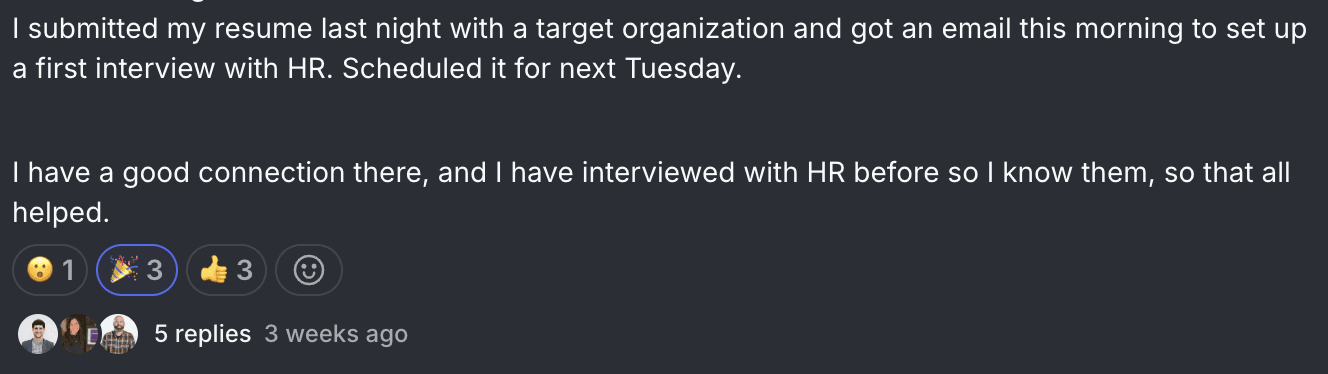
I submitted my resume last night with a target organization and got an email this morning to set up a first interview with HR.
🤝 WHO WILL HIRE ME?: 5 ministry friendly organizations with jobs for ex-pastors.
Because of the time sensitive nature of job postings, we post these in the email newsletter only.
Get the newsletter, along with 1400+ others, every Friday morning.


How we can help you:
FREE Ultimate Guide To Your Ministry To Marketplace Transition Our entire process in a free (yes, FREE) guide that walks you step-by-step through the essentials of landing a marketplace job that you'll enjoy, and supports your family. Each section builds on the next: clarity, translation, resume, and LinkedIn connections… everything you need to start seeing traction in your search. You can sign up here >>> Sign up for the Ultimate Guide.
The Ministry To Marketplace Interview Accelerator Join 162+ others who have successfully transitioned from ministry into marketplace jobs that value their experience. The Interview Accelerator will give you our proven step-by-step process, coaching, and community for getting more interviews for jobs that value your ministry experience and support your family. Let's hop on a call!
Was this forwarded to you? Get this newsletter into your inbox, along with 1400+ others, every Friday morning. Subscribe here.